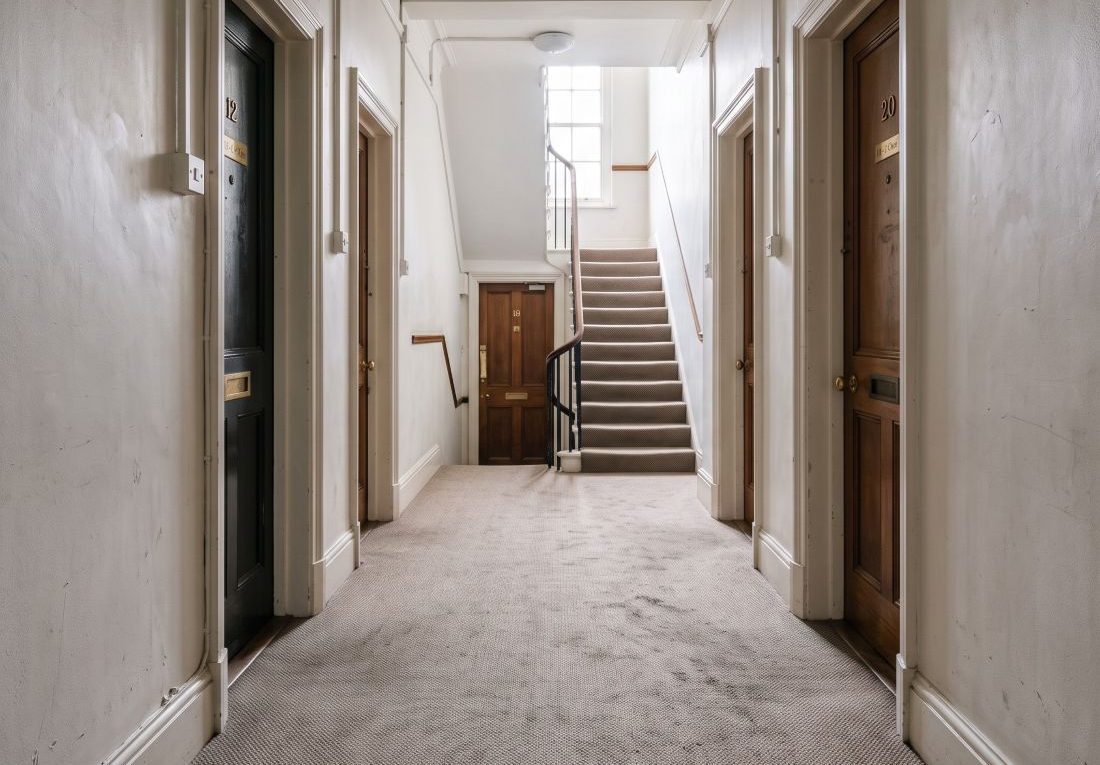
Cleaning Communal Hallway Carpets in Mansion Blocks: Who’s Responsible?
There is a particular kind of tension that lives in the communal hallways of London mansion blocks – quieter than a neighbour dispute about noise, more persistent than a disagreement over the recycling bins, and considerably more visible than either. It lives in the carpet. Specifically, in the state of it. The muddy footprints trailing up from the ground floor. The mystery stain outside flat seven that has been there since at least the second lockdown. The general greyish grimness of a carpet that gets the foot traffic of a small hotel and the cleaning attention of, well, almost nobody. If you’ve ever stood in your building’s hallway and wondered who on earth is supposed to be dealing with this, you are not alone – and the answer, like most things involving leasehold property in London, is technically straightforward and practically complicated.
The Responsibility Question – And Why It’s Murkier Than It Should Be
Freeholders, Managing Agents, and the Small Print
In the majority of London mansion blocks, communal areas – including hallways, staircases, landings, and any carpeting within them – are the responsibility of the freeholder, typically managed on their behalf by a managing agent. The service charge that leaseholders pay each year is supposed to cover, among many other things, the routine cleaning and maintenance of these shared spaces. This is not a grey area in principle. In practice, however, the frequency, quality, and definition of “cleaning” can vary so dramatically between buildings and management companies that the same legal framework produces wildly different outcomes from one mansion block to the next.
Some buildings have a contracted cleaner visiting twice a week. Others have a cleaner nominally on the schedule who appears sporadically, pushes a mop around the hard floor areas near the entrance, and treats the carpeted upper landings as entirely optional. If you are a leaseholder who has been paying a service charge that includes a cleaning provision and your hallway carpet looks like it belongs in a pub that has given up, it is entirely reasonable to raise this formally with your managing agent and request a schedule and evidence of what is actually being done.
Residents’ Management Companies – When Leaseholders Run the Building
An increasing number of London mansion blocks are managed through residents’ management companies, where the leaseholders have collectively taken on the management function themselves – often after a prolonged and character-building dispute with a previous freeholder. This is, in many respects, the better arrangement. It also means that the responsibility for the communal carpet’s condition lands squarely among the residents themselves, which is either empowering or a source of low-level committee friction, depending on your building’s particular personality.
In these setups, decisions about cleaning frequency, contractor selection, and budget allocation are made collectively – usually by a small group of directors who did not fully appreciate what they were signing up for. The upside is accountability and genuine control. The downside is that agreeing on anything involving shared expenditure among London leaseholders is an acquired skill, and the hallway carpet can deteriorate considerably during the negotiation process.
What “Communal Cleaning” Usually Means in Practice
The Gap Between the Contract and the Corridor
Here is an uncomfortable truth about communal cleaning contracts in residential mansion blocks: they are frequently written around hard surfaces and basic tidying, with carpet cleaning treated as an occasional add-on rather than a core provision. A building’s standard cleaning contract might include weekly vacuuming of carpeted areas, which sounds reasonable until you consider that the communal hallway of a twelve-flat building is absorbing twelve households’ worth of foot traffic daily – in all weathers, across all seasons, from people carrying everything from muddy bicycles to grocery deliveries to suspiciously large pieces of flat-pack furniture.
Vacuuming under these conditions is maintenance, not restoration. It slows the rate of deterioration and keeps surface soiling manageable, but it does not address the compacted grime in the lower pile, the salt residue deposited through winter, the accumulated particulate matter that no domestic vacuum reaches effectively, or the occasional stain event that gets blamed on everyone and cleaned up by no one. Communal hallway carpets in active mansion blocks typically need a professional deep clean at least once a year – ideally twice – and very few cleaning contracts specify this with any precision.
Defining What You’re Actually Paying For
If you are a director of a residents’ management company, or simply a leaseholder with enough patience to read the relevant sections of your service charge accounts, it is worth establishing exactly what the cleaning provision covers. Request the actual contract from your managing agent. Look for whether carpet cleaning is specified separately from general cleaning, whether a minimum frequency is stated, and whether there is any provision for reactive cleaning following a significant stain event. If the contract is vague – and many are – this is the moment to tighten it up, ideally before the carpet in question requires full replacement.
The Carpet Itself – Why Communal Hallways Are a Particular Challenge
Communal hallway carpets in mansion blocks exist in a uniquely punishing set of conditions. They receive no rest – unlike a domestic carpet that sits undisturbed for hours at a time, a hallway carpet in an occupied building is in near-constant use across a long daily window. They are exposed to outdoor soiling brought in from the street with every entry, which in London means clay-heavy soil, diesel particulates, and in winter, a combination of rain and road salt that is particularly corrosive to carpet fibres. They cannot be moved, dried in sunlight, or treated in isolation from the environment around them.
Most communal hallway carpets are specified with all of this in mind – they tend to be dense, flat, or low-pile constructions in dark or multi-tonal colours that conceal soiling rather than displaying it. This is sensible, and it also means that the carpet can be genuinely quite dirty before it looks genuinely quite dirty. By the time the hallway carpet starts looking bad to the casual eye, it has usually been in a bad state by any professional assessment for quite some time.
Fibre type varies enormously between buildings. Older mansion blocks – particularly in Islington, Hackney, and the inner East London boroughs – often have wool or wool-blend carpets in communal areas, sometimes original to significant refurbishments and worth preserving properly. Newer conversions more commonly use contract-grade synthetic carpet, which is more tolerant of aggressive cleaning methods and higher moisture levels. Knowing which you’re dealing with determines the appropriate cleaning chemistry and methodology entirely.
Professional Cleaning for Communal Areas – What to Expect
Specifying the Right Service
A professional clean of a communal hallway carpet should begin with an assessment, not a machine. A competent contractor will identify the fibre type, note any existing staining or damage, assess the level of embedded soiling, and recommend the appropriate method – hot water extraction for robust synthetics, low-moisture encapsulation or dry-compound methods for wool or for buildings where drying time is a practical constraint. The latter matters more than it might seem: a communal hallway that needs to be passable throughout the day cannot be left saturated for four hours while residents step around wet carpet and “caution – cleaning in progress” signs.
Spot treatment of existing stains should be included as part of any professional communal clean, not charged as a separate line item. Any contractor who quotes for the area and then adds supplementary charges for treating obvious staining upon arrival is worth questioning.
Frequency, Timing, and Resident Communication
Once a year is the realistic minimum for a professionally deep-cleaned communal hallway in an active mansion block. Twice a year is better – once in spring, once in autumn – which brackets the worst soiling periods and keeps the carpet in a condition where maintenance cleaning between professional visits is actually effective. Scheduling should account for resident movement patterns where possible: a Saturday morning in a building full of working professionals is considerably less disruptive than a weekday afternoon in a building with young families, elderly residents, or anyone who has strong opinions about having their route to the front door blocked by cleaning equipment.
A brief note to residents in advance – whether through a shared WhatsApp group, a notice board, or a politely worded email from the management company – prevents the special kind of indignation that arises when someone in slippers encounters a professional carpet cleaner at seven forty-five in the morning without prior warning.
Five Things Worth Knowing Before the Argument Starts
Managing communal carpet cleaning without a framework tends to produce the same predictable frictions between neighbours – usually centred on cost, responsibility, and differing standards of what constitutes acceptable. A few things worth establishing before the conversation turns difficult.
Service charge funds collected for maintenance cannot generally be redirected to other uses by a managing agent without leaseholder agreement – if cleaning is specified in the budget and not being delivered, that is a legitimate grounds for a formal query. A written log of reported stain events or cleaning deficiencies, however informal, is far more useful than an email sent once and forgotten when it comes to establishing a pattern. Replacement costs for communal hallway carpet in a mansion block are almost always substantially higher than the cost of regular professional maintenance – a figure worth calculating concretely if a reluctant freeholder or cost-conscious management company needs persuading. And finally: the leaseholder who raises the condition of the communal carpet at the AGM is not being difficult. They are, in all probability, doing everyone a favour.