Wool or Polypropylene? How to Identify What Your Rental’s Carpet Is Actually Made Of
A letting agent on Upper Street sent me a check-out report last March describing the second bedroom as “100% wool twist, heavily soiled, requires specialist restoration”. It was polypropylene. Solution-dyed, tufted, sitting on a woven plastic secondary backing, and the soiling was a single coffee spill that had wicked back up from the underlay twice since the tenant first reported it. The proposed deduction was £340.
The mistake runs in both directions. I have watched a tenant in a Canonbury Square conversion attack a genuine wool Wilton with supermarket oxygen bleach, on the reasoning that carpet is carpet, and pull the colour out in three pale clouds across the bay window. Nobody in that chain – agent, landlord, tenant – had spent ten minutes finding out what was on the floor.
Why does the fibre change what can safely be done to the carpet?
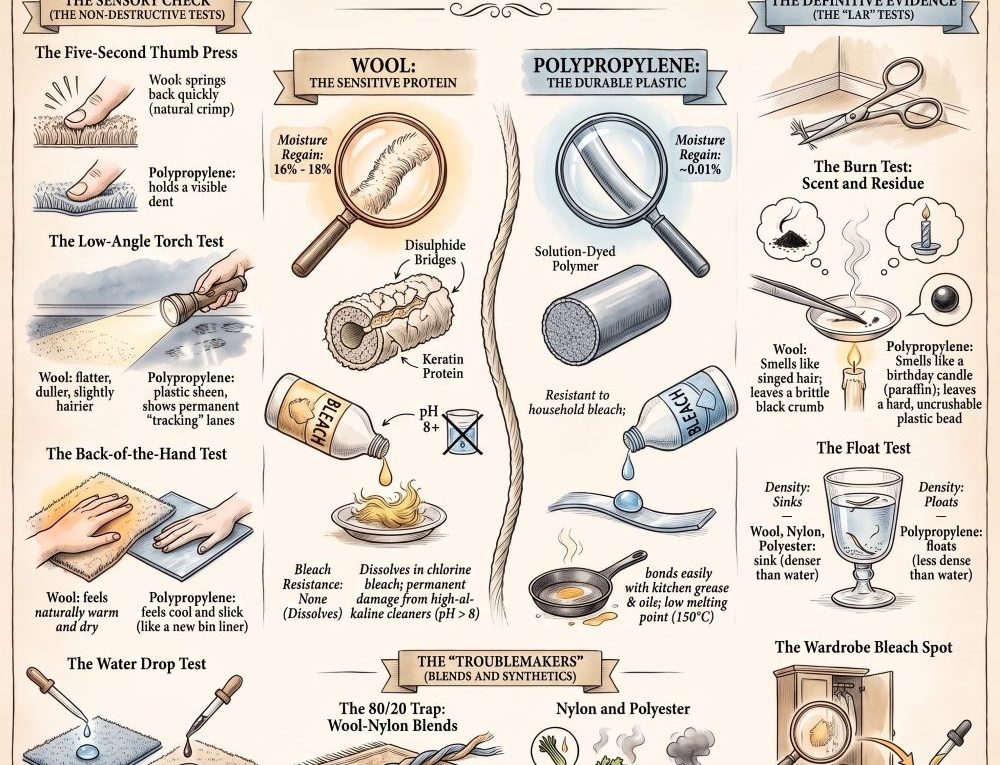
Wool is protein. Keratin, held together partly by disulphide bridges between cystine residues, and those bridges come apart in alkaline conditions. Push a prespray past pH 8 and you soften the fibre’s handle permanently. Chlorine bleach dissolves it outright. Wool also carries a moisture regain of around sixteen to eighteen per cent, meaning it absorbs a lot of water before it even feels damp – which is why overwetting a wool carpet in a Barnsbury basement flat produces dye migration and a brown cellulosic tidemark drawn up out of the jute.
Polypropylene is a plastic. The polymer chain offers almost nothing for a dye molecule to hold onto, so the colour is added at the melt stage before the filament is extruded. That single manufacturing fact is why household bleach at one part in ten will strip a red wine stain off a polypropylene loop and leave the colour underneath untouched. Moisture regain is roughly 0.01 per cent. It dries in an hour. It also softens somewhere around 150°C, and it loves oil – the fibre is oleophilic, so kitchen grease and body oils bond to it and pull soil back within days of a clean.
That’s the theory.
What goes wrong when you guess
Run a hot extraction at full temperature across a polypropylene twist and you get glazing: the filament tips deform, catch the light differently, and the traffic lane looks permanently dirty even after the soil has gone. Run a high-alkaline traffic lane cleaner across wool and the fibre goes coarse under the hand, dyes bleed at the seams, and the damage does not reverse. I have been called to a flat off Amwell Street to fix the second of those. There is no fixing it.
What does the carpet tell you before you cut anything into it?
Press your thumb hard into the pile for a count of five and lift it. Wool springs back, mostly, within a minute – the fibre has a natural crimp and a genuine elastic recovery. Polypropylene holds the dent. That single test sorts maybe seventy per cent of the rentals I walk into. That’s the theory, anyway, and it holds up better than the paperwork does.
Then look at it under a torch held low and sideways, rather than under the ceiling light. Polypropylene has a faint plastic sheen and shows shading and tracking down hallways, because the filaments have taken a permanent set from footfall rather than becoming soiled. Wool looks flatter, duller, and hairier. Wool also sheds – if the tenant tells you the vacuum has been filling with pale fluff for eight months and the pile hasn’t visibly thinned, that is a wool carpet doing exactly what wool carpets do for their first year.
Temperature helps. Put the back of your hand flat on the pile for a few seconds. Wool feels warm and slightly dry. Polypropylene feels cool and faintly slick, almost waxy, like the inside of a new bin liner.
Reading the backing and the seams
Lift the carpet where it meets a threshold bar, or at the corner behind the radiator pipe where the fitter has left slack. A jute hessian secondary backing with a chalky latex layer, and a woven structure visible from the reverse, points hard at wool – Wiltons and Axminsters were built that way and the cheap end of the market never bothered. A woven plastic action back with neat tufting rows stitched through it tells you the carpet is tufted, which is most of Islington’s rental stock, and tufted covers both fibres. Manufacturers print their name and composition on the backing in a repeating stripe. Half the time it has worn off. The other half it answers the question in four seconds and I have driven across the borough for less.
How do you run a burn test without wrecking the carpet?
This is the definitive test and everyone is scared of it, unnecessarily. You are not burning the carpet. You are burning six or eight filaments.
Take the sample from inside a fitted wardrobe, under a sofa foot, or from the strip behind the bedroom door where it never gets walked on. Pinch a tuft, twist it, and cut the very tips with nail scissors – you want fibre, not a plug. Nobody will ever find the spot. Do this over a ceramic saucer, next to an open window, with the flame well away from the pile itself. Tweezers, not fingers.
Wool resists ignition. It needs the flame held on it, it burns with a slow orange sputter, and the moment you pull the lighter away it goes out on its own. The residue is a black, brittle crumb that collapses to grey powder when you pinch it. The smell is unmistakable: burning hair, because that is chemically what it is.
Polypropylene does something completely different. It shrinks away from the flame before it lights, melts and drips, burning with a blue base and a sooty tip. Left alone it keeps going. The residue is a hard, glossy bead that you cannot crush between finger and thumb – it just rolls. The smell is candle wax, or a blown-out birthday candle, or paraffin.
Two other fibres show up in London rentals often enough to catch you out. Nylon melts like polypropylene, but the bead is tougher and greyer, and the smell is vegetal – people describe it as celery, or greens left too long on the hob. Polyester gives thick black smoke, a sweetish chemical smell, and a very hard black bead. Neither of those is wool, and for cleaning purposes that is usually all you need to establish. That’s the theory working properly for once: four fibres, four distinct behaviours in a saucer.
What each smell is telling you
The burning hair note is sulphur, released from the cystine in the keratin. If you smell it, you have a protein fibre, and protein fibres get pH-controlled cleaning and nothing above about pH 8.5. The waxy note means a pure hydrocarbon chain with no functional groups worth speaking of – which also means no acid dye sites, which means solution-dyed, which means bleach is on the table. Celery means an amide linkage: nylon, dyed with acid dyes, and vulnerable to the same colour bleed as wool despite being a plastic.
Which checks work when you cannot take a sample at all?
Sometimes you are on the phone to a tenant in Highbury who is not going near their carpet with a lighter. Fair enough.
The float test settles it. Polypropylene has a density of about 0.905 grams per cubic centimetre, which is lower than water, so a pinch of loose fibre dropped into a glass will sit on the surface and stay there. Wool sinks. So do nylon and polyester. This is the only fibre identification test I know that gives a binary answer with no interpretation required.
A water drop tells you something too. Flick a single drop onto the pile and watch for thirty seconds. On polypropylene it beads and sits there like rain on a waxed jacket. On wool it darkens the fibre and disappears.
The bleach spot, and why I only do it in wardrobes
A drop of diluted household bleach on a hidden tuft, left ten minutes, is fast and conclusive. Solution-dyed polypropylene comes through unchanged. Wool goes yellow, then gelatinous under the fingernail. I do this inside wardrobes and airing cupboards only, and I tell landlords when I have done it, because a bleach spot in the wrong place is exactly the kind of thing that turns up in a check-out photograph eighteen months later with my name attached to it.
What does the answer change about the deposit and the invoice?
Inventory clerks copy the developer’s original spec sheet, and developers change carpet suppliers between phases. That is the root of most of the disputes I get pulled into. A deposit adjudicator looks at evidence, and a dated photograph of a melted bead on a saucer next to a fibre sample carries more weight than an inventory line typed in 2019.
Here is the part my accountant dislikes. If your rental has solution-dyed polypropylene – and across the Caledonian Road and Hornsey Road end of the borough, most of it does – a hired machine and a bottle of thin bleach will get you ninety per cent of the way to what I charge £180 for. Do that first. Call someone like me when there is wicking that keeps coming back, or a landlord threatening a full replacement.
The blends that fool everybody
The one that catches people out is the 80/20 wool-nylon blend, the standard specification for anything mid-market laid between about 1998 and 2015, and still common in the ex-local-authority flats around the Packington estate. Burn a bundle and you get both behaviours at once: some filaments crumble to grey ash, others shrink and bead. That is the blend announcing itself. Treat the whole carpet as wool – the nylon takes acid dyes exactly as wool does, so it bleeds under the same conditions, and the pH ceiling is set by the weaker fibre. Twenty per cent nylon buys the carpet abrasion resistance and buys you nothing at all in chemical latitude.
And I will say the unpopular thing: specifying wool for a two-bed flat that turns over every eleven months is a landlord’s vanity purchase. It is a beautiful fibre and it wants a house where somebody takes their shoes off. In a rental it gets moth larvae in the wardrobe corner and a tenant who has no idea any of this matters.
The carpet in that Upper Street bedroom is still down, incidentally. The coffee mark came out with bleach and a rinse, in about forty minutes.